Systematic Analysis of Binary Sequences
In the following section we describe some relevant properties of binary sequences, i.e. series of notes created by cyclically applying an operator (Im, Jn) to a starting pitch, by using the web application GeCo-Tool based on the Interval Matrix.
Investigating Sequence Length
It is quite obvious that the length of a binary sequence depends on the interval (I) and leap (J) parameters. What is less obvious is what this dependency is.
Let us start with an example. The binary sequence (I3, J−1) is that shown in Figure 1.

Figure 1 — Binary sequence for I3 and J−1.
First of all, we note that a different (complementary) interpretation of the succession of interval and leaps can be established in terms of interval between the starting note and the successive, and of jump between the same note and the third one. In other words, when we apply the binary operation (3, −1) to the note "C" we generate the sequence:
where we apply a minor third (3m) interval to the first note "C", followed by a descending minor second leap (−2m) to the second note "E♭". Looking at the whole sequence of Figure 1 we can also interpret this as 3m intervals with tonal movements, i.e. one-tone leaps this time starting from the initial notes (C, D, E, F♯, G♯, B♭). This picture is better explained in Figure 2.

Figure 2 — A different interpretation of the (I3, J−1) binary operation.
The red and blue lines highlight the presence of two parallel sequences of tones — two hexatonal scales — separated by a minor third interval, or equivalently, a sequence of minor third intervals with one-tone movement. (The jump is referred to the first note, while the leap in GeCo-Tool refers to the second one.) It should also be clear that the "jump" consists in the algebraic sum of the interval I and the leap J. Indeed, in the example 3 + (−1) = 2. We will call S this sum:
Notable Properties of Binary Sequences
We are interested in investigating the dependence of the sequence length from the interval/leap parameters. It is rather simple to verify, by means of GeCo-Tool, that all sequences sharing the same S have the same length. Therefore, a sequence obtained applying a major second interval (m = 2) followed by a fourth leap (n = 5), i.e. having S = 7, consists of major second intervals with fifth movements, as Figure 3 shows.

Figure 3 — Binary sequence for I2 and J5.
We can count the notes: they are 25, or 24 plus the final one coinciding with the first by the well-known "closure" property. In fact, the length of the (I2, J5) sequence is the same as that of (I7, J0), which consists of perfect fifth intervals (7 semitones) with perfect fifth jumps, i.e. with "repeated notes", as Figure 4 clearly shows.

Figure 4 — Binary sequence for I7 and J0.
It is clear that we are going through the circle of fifths, which consists of 12 notes; therefore (as every note is played two times) the total length is 2 × 12 + 1 = 25.
Ultimately, to determine the length of all possible binary sequences, it suffices to calculate the length of the "constant-sum" sequences with repeated terms: (I2, J0), (I3, J0), … (I11, J0). Table 1 shows all those lengths as a function of S = m + n (coinciding with m, as n = 0). As S measures the jump width — the intensity of the "movement" — the length is a non-linear function of S.
| Binary operator | S | Sequence length |
|---|---|---|
| I2 J0 | 2 | 13 |
| I3 J0 | 3 | 9 |
| I4 J0 | 4 | 7 |
| I5 J0 | 5 | 25 |
| I6 J0 | 6 | 5 |
| I7 J0 | 7 | 25 |
| I8 J0 | 8 | 7 |
| I9 J0 | 9 | 9 |
| I10 J0 | 10 | 13 |
| I11 J0 | 11 | 25 |
Table 1 — Length of binary sequences as a function of the jump width S.
Some of the results in Table 1 are quite obvious upon closer inspection. For example, whenever S is a submultiple of 12, as in cases I4J0 and I3J0. In the former we have only 3 different notes, each played twice, plus the last note: 3 × 2 + 1 = 7. In the latter, we have 4 different notes, each played twice, plus the last note: 4 × 2 + 1 = 9. The two cases are compared in Figure 5.
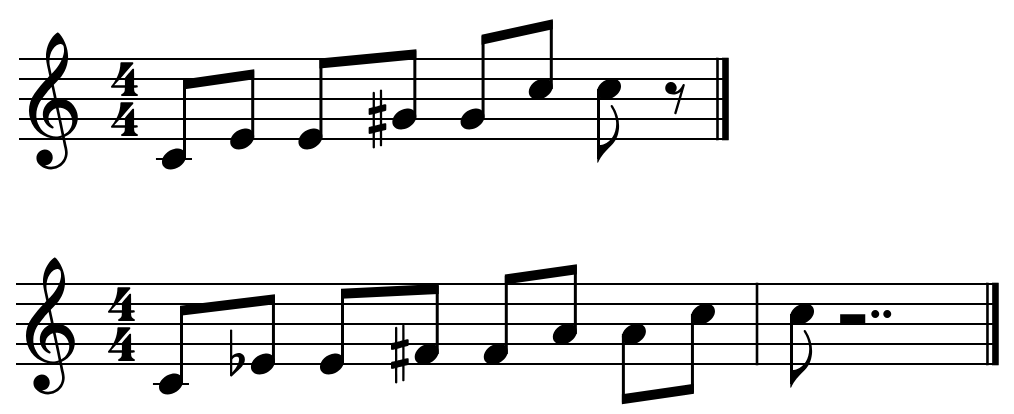
Figure 5 — Binary sequences for I4J0 and I3J0.
Movements
Of course binary sequences having a zero leap are not so interesting. The meaningfulness of sequences suddenly increases if we replicate the results of the above table with a descending semi-tonal leap J−1. Table 2 shows what happens in that case, in terms of intervals and jumps (algebraic sums of intervals and constant leap = −1).
| Binary operator | S | Sequence length | Annotations |
|---|---|---|---|
| I1 J−1 | 0 | 3 | three notes, ex. C C♯ C — of no interest |
| I2 J−1 | 1 | 25 | major second interval, with semi-tonal jumps |
| I3 J−1 | 2 | 13 | minor third interval, with one-tone jumps |
| I4 J−1 | 3 | 9 | major third interval, with minor third jumps |
| I5 J−1 | 4 | 7 | perfect fourth interval, with major third jumps |
| I6 J−1 | 5 | 25 | diminished fifth interval, with perfect fourth jumps |
| I7 J−1 | 6 | 5 | perfect fifth interval, with diminished fifth jumps |
| I8 J−1 | 7 | 25 | augmented fifth interval, with perfect fifth jumps |
| I9 J−1 | 8 | 7 | sixth interval, with augmented fifth jumps |
| I10 J−1 | 9 | 9 | minor seventh interval, with sixth jumps |
| I11 J−1 | 10 | 13 | major seventh interval, with minor seventh jumps |
| I12 J−1 | 11 | 25 | octave interval, with major seventh jumps |
Table 2 — Characteristics of binary sequences (InJ−1).
The results of Table 2 are summarized in Table 3 below.
| S | Operator | Score |
|---|---|---|
| 0 | I1J−1 | 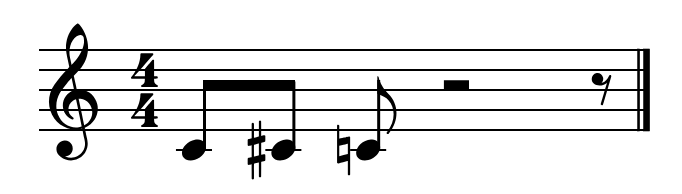 |
| 1 | I2J−1 |  |
| 2 | I3J−1 | |
| 3 | I4J−1 | 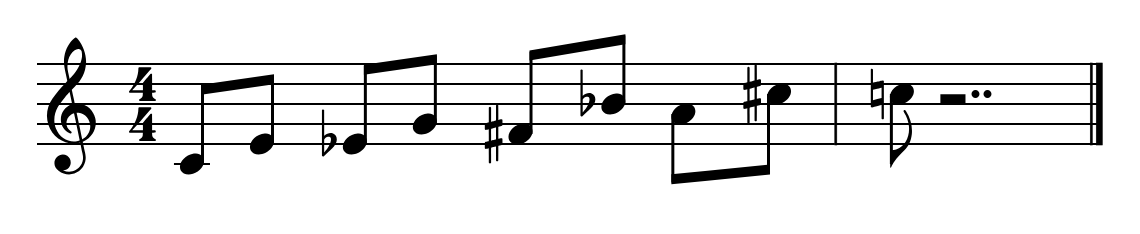 |
| 4 | I5J−1 | 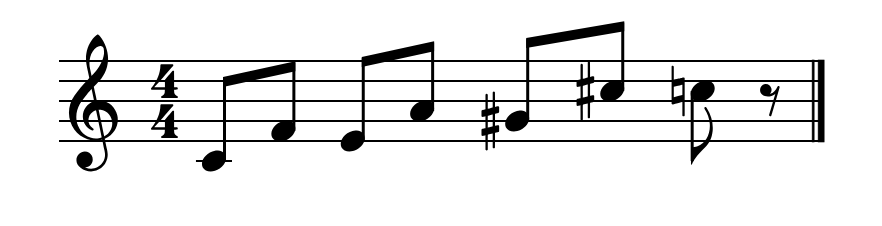 |
| 5 | I6J−1 |  |
| 6 | I7J−1 | 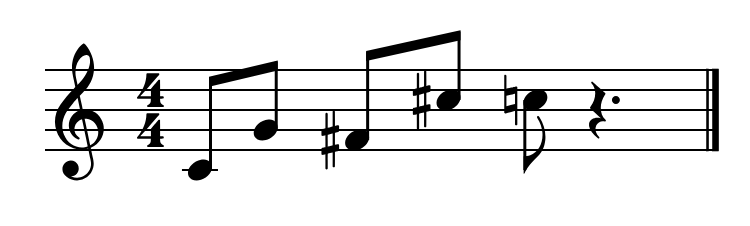 |
| 7 | I8J−1 |  |
| 8 | I9J−1 |  |
| 9 | I10J−1 | 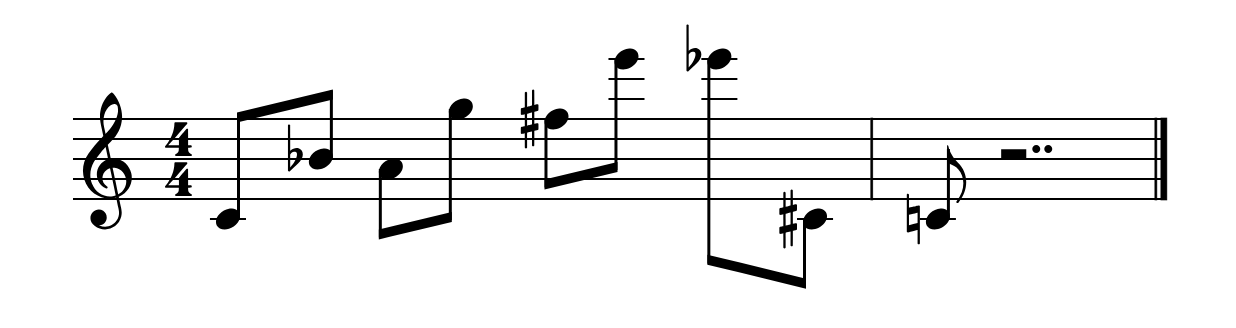 |
| 10 | I11J−1 | 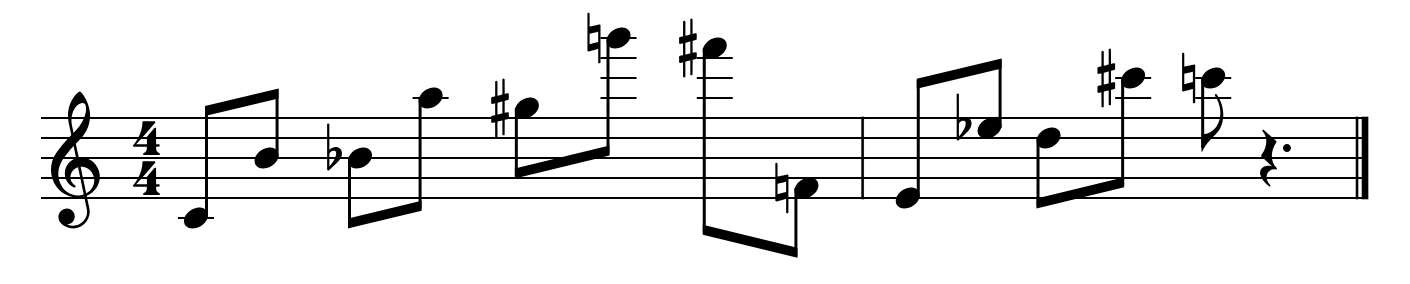 |
| 11 | I12J−1 |  |
Table 3 — Binary sequences (InJ−1).
Ascending and Descending Interval Pairing
It's time to delve into the realm of applications: the focus of this section is a systematic study of interval pairing.
We will show by means of examples how to use the binary system to generate interval pairs. It is a very powerful tool to practice intervals on any instrument and exploring different sounds. New ideas can be developed to be used for improvisation or compositions on both tonal or atonal music. It can also be used for ear training: a sequence is generated, the user can sing it and then play it with GeCo-Tool. By lowering the BPM, the user can sing along the sequence to improve intonation.
By using the transformations, the intervals can be played as ascending–ascending, ascending–descending, descending–ascending and descending–descending. For instance, a sequence of major seconds (interval) played by ascending fourths (leap) can also be played as descending major seconds by ascending fourths, or ascending major seconds by descending fourths, and so on.
Theoretical Rule
The present formulation is specifically constructed to preserve ascending intervallic identities within each binary unit. By applying In and Jm to a reference pitch, the interval is generated independently of the displacement mechanism that governs the progression of the sequence. This separation ensures that interval classes are consistently realized as ascending structures, while the jump defines the movement of the generative framework itself.
In Forte's pitch-class set theory, intervals are understood not according to their traditional tonal function, but through their abstract distance relationships measured in semitones. A central concept is that of the interval class (IC), which groups together intervals that are inversionally equivalent. Rather than distinguishing between, for example, a major second and a minor seventh, Forte theory considers both as manifestations of the same intervallic identity because they complement each other within the octave. Thus, intervals are reduced to the smallest possible distance within the twelve-tone chromatic system. The six interval classes are therefore defined as:
This abstraction allows pitch-class sets to be analyzed independently of register, ordering, or tonal hierarchy, emphasizing instead the internal intervallic structure of musical collections.
Consequently, the system maintains intervallic coherence at the local level, while enabling flexible and directional evolution at the global level. Based on this concept, for instance, to generate an interval of a major second with respect to the first note of the couple, it is possible to compute the number of semitones from the second note to descend to the target note.
Each cell of the interval matrix contains a binary operator:
where In generates the second note of the pair, while Jm connects that second note to the first note of the next pair.
If the next starting pitch is displaced by s semitones from the original pitch, then:
Thus:
and the leap is:
For example, major sevenths moving by minor seconds are represented by:
because:
where C♯ is a half step above C, and: 1 − 11 = −10. In set-class theory they both belong to IC1.
Although the present matrix is constructed to preserve ascending intervallic identities within each local binary structure, every generated sequence may also be realized in descending form through transpositional and inversional operations. In GeCo-Tool, this process is implemented through pitch-class transformations derived from serial music theory, particularly inversion I and transposition T.
The inversion operation reflects the intervallic profile around the first pitch of the sequence, transforming ascending motions into descending ones while preserving interval-class relationships. Subsequent transposition allows the transformed structure to be repositioned onto any pitch-class level without altering its internal organization.
Consequently, the interval matrix should not be interpreted as a collection of fixed melodic contours, but rather as a system of intervallic operators capable of generating multiple directional realizations. The ascending formulation therefore represents the canonical structural form, while descending configurations emerge as transformed equivalents preserving the same intervallic identity.
For this reason, from the major seventh, the leap must be negative. Table 4 lists all the combinations in the interval matrix.
| unison | 2m | 2M | 3m | 3M | 4 | 5♭ | 5 | 5♯ | 6 | 7m | 7M | |
|---|---|---|---|---|---|---|---|---|---|---|---|---|
| unison | I0J0 | I0J1 | I0J2 | I0J3 | I0J4 | I0J5 | I0J6 | I0J7 | I0J8 | I0J9 | I0J10 | I0J11 |
| 2m | I1J−1 | I1J0 | I1J1 | I1J2 | I1J3 | I1J4 | I1J5 | I1J6 | I1J7 | I1J8 | I1J9 | I1J10 |
| 2M | I2J−2 | I2J−1 | I2J0 | I2J1 | I2J2 | I2J3 | I2J4 | I2J5 | I2J6 | I2J7 | I2J8 | I2J9 |
| 3m | I3J−3 | I3J−2 | I3J−1 | I3J0 | I3J1 | I3J2 | I3J3 | I3J4 | I3J5 | I3J6 | I3J7 | I3J8 |
| 3M | I4J−4 | I4J−3 | I4J−2 | I4J−1 | I4J0 | I4J1 | I4J2 | I4J3 | I4J4 | I4J5 | I4J6 | I4J7 |
| 4 | I5J−5 | I5J−4 | I5J−3 | I5J−2 | I5J−1 | I5J0 | I5J1 | I5J2 | I5J3 | I5J4 | I5J5 | I5J6 |
| 5♭ | I6J−6 | I6J−5 | I6J−4 | I6J−3 | I6J−2 | I6J−1 | I6J0 | I6J1 | I6J2 | I6J3 | I6J4 | I6J5 |
| 5 | I7J−7 | I7J−6 | I7J−5 | I7J−4 | I7J−3 | I7J−2 | I7J−1 | I7J0 | I7J1 | I7J2 | I7J3 | I7J4 |
| 5♯ | I8J−8 | I8J−7 | I8J−6 | I8J−5 | I8J−4 | I8J−3 | I8J−2 | I8J−1 | I8J0 | I8J1 | I8J2 | I8J3 |
| 6 | I9J−9 | I9J−8 | I9J−7 | I9J−6 | I9J−5 | I9J−4 | I9J−3 | I9J−2 | I9J−1 | I9J0 | I9J1 | I9J2 |
| 7m | I10J−10 | I10J−9 | I10J−8 | I10J−7 | I10J−6 | I10J−5 | I10J−4 | I10J−3 | I10J−2 | I10J−1 | I10J0 | I10J1 |
| 7M | I11J−11 | I11J−10 | I11J−9 | I11J−8 | I11J−7 | I11J−6 | I11J−5 | I11J−4 | I11J−3 | I11J−2 | I11J−1 | I11J0 |
Table 4 — Interval matrix used to compute pairs of ascending intervals.
Examples
Below an example is provided where intervals of minor seconds are generated by jumps of perfect fourths:

Minor second intervals with perfect fourth movements (I1J4).
The next example generates minor thirds at leaps of ascending major seconds. Note that the first two eighth notes are a minor third apart and the third note is a major second from the first note, and so forth:

Minor third intervals with major second movements (I3J−1).
By inverting this binary sequence,
the intervals are descending minor thirds: the first two notes are a descending minor third apart, and the third note is a whole tone from the first note. In tonal music it would be a minor seventh, but in pitch-class set theory this interval belongs to the same interval class as the major second.

Descending minor thirds — inversion of I3J−1.
The following example depicts diminished fifths ascending by perfect fourths (IC6 followed by IC5):

Diminished fifth intervals with perfect fourth movements (I6J−5).
The following example depicts minor sevenths ascending by perfect fifths. In pitch-class theory the minor seventh and the major second belong to the same interval class IC2. Therefore it is IC2 followed by IC5, where IC5 is the interval with respect to the first note of the binary group:

Minor seventh intervals with perfect fifth movements (I10J−3).